Nature’s Marvel: Growing Roots with Just Branches and Leaves
In the realm of botanical wonders, there exists an almost magical phenomenon that leaves both seasoned gardeners and curious onlookers in awe—the ability of branches and leaves to sprout roots and grow into flourishing plants. This seemingly unbelievable process defies conventional expectations, revealing the resilience and adaptability of nature. Let’s delve into the enchanting world where branches and leaves transform into thriving plants with their own roots.
1. The Miraculous Nature of Propagation:
Propagation through branches and leaves is a form of asexual reproduction, commonly known as vegetative propagation. This natural process allows plants to reproduce without the involvement of seeds, showcasing the incredible adaptability of certain species.
2. Harnessing the Power of Nodes:
The key to this extraordinary growth lies in specialized structures called nodes. Nodes, found along the length of stems and branches, contain dormant buds and cells capable of transforming into roots. When exposed to the right conditions, these nodes spring into action, initiating the growth of roots.
3. Water and Soil: The Catalysts for Transformation:
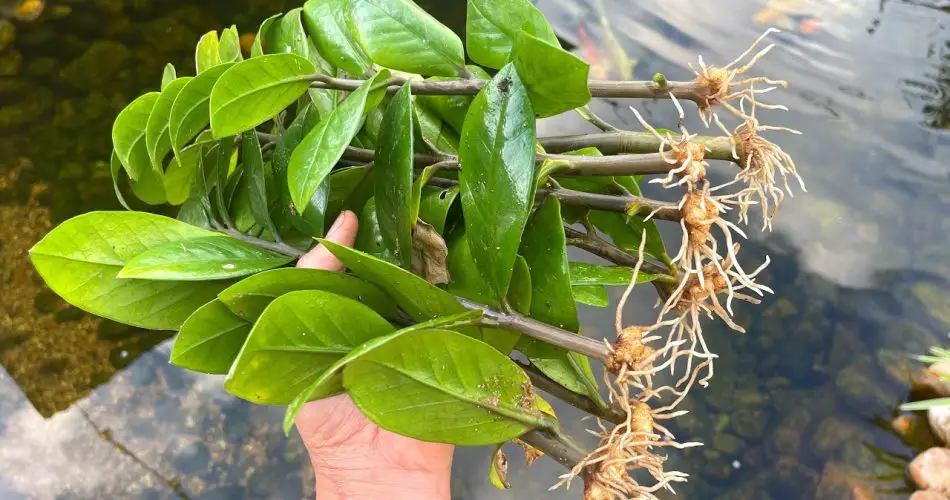
The simplicity of the process is astonishing—placing cut branches or leaves in water or soil initiates the growth of roots. Water acts as a conduit for the initial stages, while soil provides the necessary nutrients for sustained development.
4. Leaves that Become Roots: The Leaf Propagation Marvel:
Certain plant species exhibit the extraordinary ability of leaves transforming into roots. In this process, a leaf is carefully removed from the parent plant and placed in a conducive environment. Over time, roots emerge from the base of the leaf, giving rise to an independent plant.
5. Branches that Take Root: The Stem Cutting Alchemy:
Stem cuttings, a widely employed method in propagation, involve snipping a section of a healthy branch and placing it in soil or water. The exposed nodes respond by generating roots, effectively giving rise to a new plant genetically identical to the parent.
6. Patience Rewarded: The Journey from Cutting to Plant:
Witnessing the transformation from a mere branch or leaf to a plant with its own roots is a lesson in patience. As the roots establish themselves, a tiny cutting evolves into a self-sufficient and thriving entity, ready to embark on its own journey of growth.
7. Widely Practiced in Horticulture:
This method of propagation is not confined to the mysteries of the wild; horticulturists and gardeners actively employ this technique to propagate desirable plant varieties. It’s a sustainable and efficient way to create new plants with desired traits.
8. Nature’s Resilience on Display:
The ability of branches and leaves to grow roots serves as a testament to the resilience and adaptability inherent in nature. It’s a survival strategy that ensures the continuation of plant species in diverse environments.
A Testament to Nature’s Ingenuity
In the seemingly magical transformation of branches and leaves into plants with roots, we witness the ingenuity of nature at its finest. This remarkable process, far from being unbelievable, stands as a testament to the resilience and adaptability encoded in the very fabric of botanical life. It invites us to marvel at the wonders of propagation and embrace the profound beauty of the natural world.